
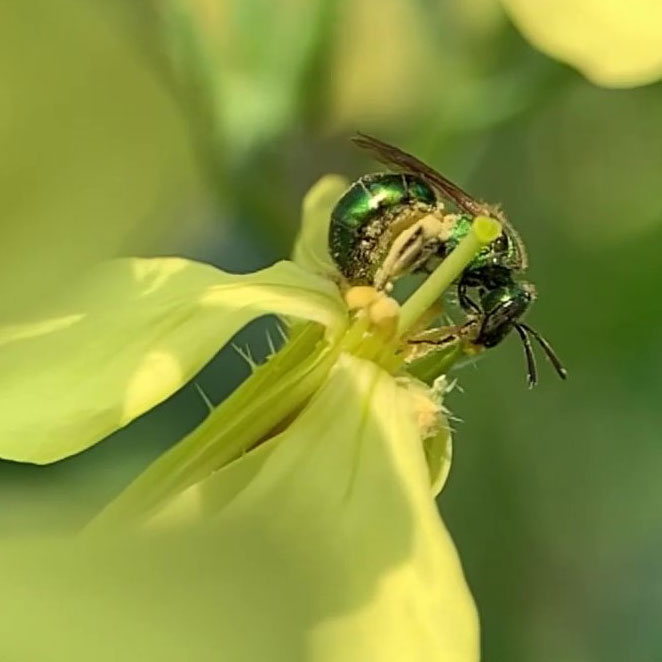
A paper that used slow-motion videos of pollinators to study why wild radish flowers have four long plus two short pollen-producing stamens, was published in September 2025 in the journal Royal Society Open Science.
The paper, titled “Testing adaptive hypotheses for an evolutionarily conserved trait through slow-motion videos of pollinators,” was penned in part by lead author Robin Waterman, a doctoral candidate at the W.K. Kellogg Biological Station, or KBS, in the Conner Lab, and in Michigan State University’s Department of Plant Biology and the Ecology, Evolution, and Behavior program.
The co-authors of the paper are:
- Sally Song, an undergraduate student from Wellesley College who spent the summer of 2022 at KBS in the Research Experiences for Undergraduates program.
- Nicholas Bhandari, an undergraduate student from the MSU Honors College who spent the summer of 2021 at KBS in the Undergraduate Research Apprenticeship program.
- Jeff Conner, a professor in MSU’s Department of Plant Biology and the Ecology, Evolution, and Behavior program, as well as a resident faculty member at KBS.
About the study
Wild radish (Raphanus raphanistrum) is commonly considered a problematic agricultural weed in some parts of the world. It served as a model organism in this study, as the stamen structure in wild radish is shared by some 4,000 relatives in the mustard family.
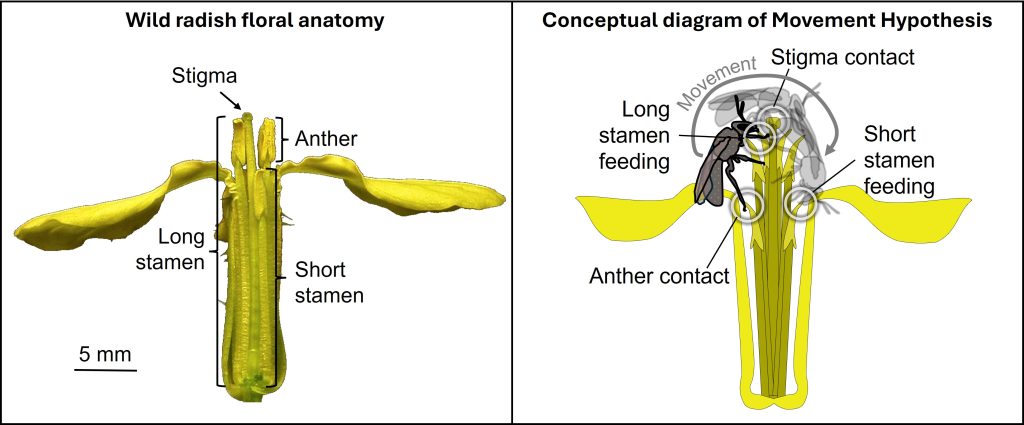
The group was curious about why the combination of four long stamens and two short stamens was a beneficial trait. They used their data to propose a few hypotheses, including that pollinators do a better job at pollinating when moving between feeding on one stamen type to another during a visit to wild radish flowers.
Prior studies conducted in the Conner Lab showed that natural selection was acting to maintain the difference in length between long and short stamens in wild radish flowers, but did not address why the trait was beneficial.
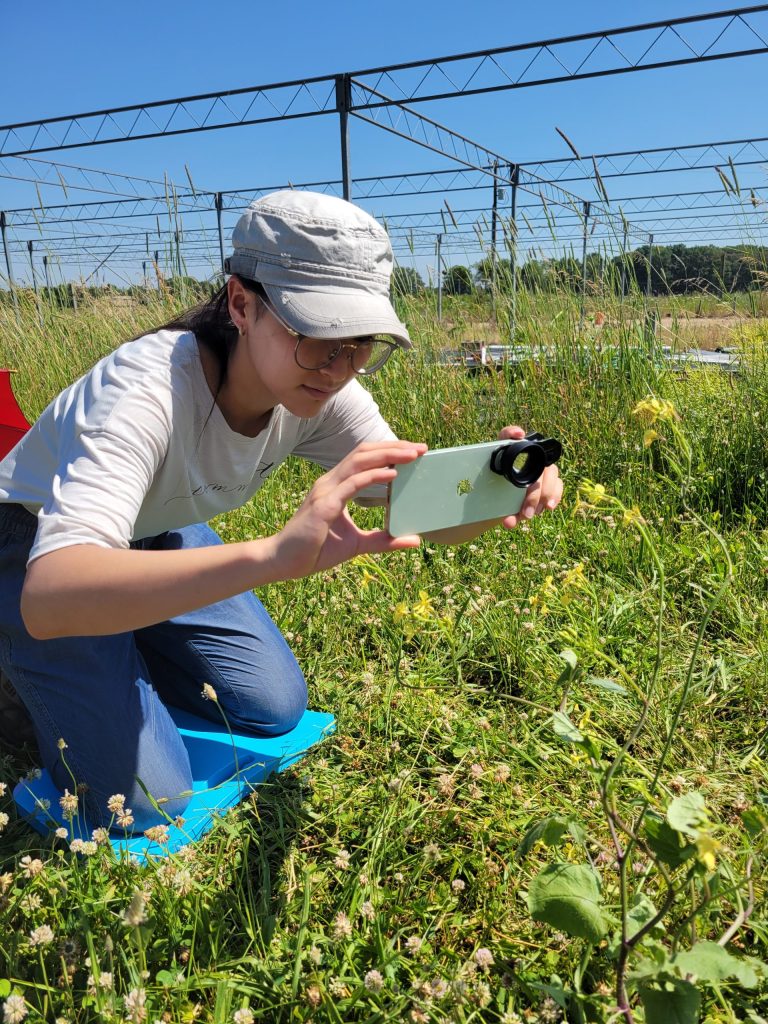
To get at that question, the group wanted a close-up view of pollination events in realistic field conditions. They filmed pollinator visits to wild radish plants across two summers at KBS, then meticulously watched and rewatched the footage to collect data, allowing a test of their hypotheses. To make sure the video-based data was translatable to physical measures, they also marked the long and short anthers of a few flowers with different colors of fluorescent dye, then captured a small set of pollinators after they’d visited these marked flowers.
By swabbing the dye off of these pollinators and counting the colors under a microscope, they were able to estimate how much pollen from the long versus short anthers the pollinator picked up during its visit. While most studies using this kind of dye swab approach euthanize the insects, this study used a non-lethal method and successfully released pollinators unharmed after they were swabbed.
Results
The group found evidence that the presence of short and long stamens increases pollinator movement and thus effectiveness — the third of three hypotheses tested in the study — but not that short and long stamens are specialized for either feeding or pollinating, or that short and long stamens are specialized for different pollinator taxa.
In line with the third hypothesis, the results showed that visits in which pollinators fed on both stamen types had greater anther and stigma contact compared with those in which pollinators fed on only one stamen type.
“Working on this project has given me a new appreciation for stamens, which perform the critical job of producing pollen in a flower. While variation in the color and shape of petals often comes to mind when thinking about flower diversity, there is actually a lot of diversity in the size, shape, color, and spatial arrangement of the stamens,” said Waterman.
“Through this study, I was pleased to shed some new light on the function of one aspect of stamen trait variation.”
A legacy of conservation; a commitment to sustainability.
3700 E. Gull Lake Drive
Hickory Corners, MI 49060
(269) 671-5117
info@kbs.msu.edu
Find us on social media.