
A Michigan State University researcher has received the Soil Science Research Award from the Soil Science Society of America — SSSA — one of the highest honors for advancing scientific knowledge in the field.
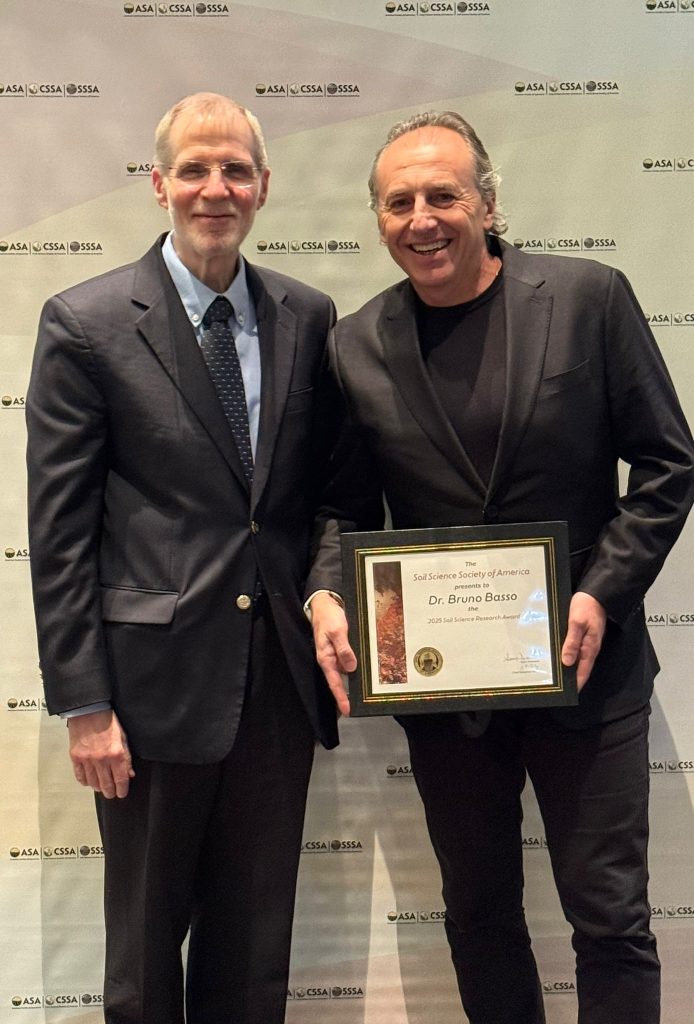
Bruno Basso, a world-renowned expert in sustainable agriculture and precision agriculture systems, was presented with the award in November 2025 at the SSSA’s CANVAS conference in Salt Lake City, Utah.
Basso is a John A. Hannah Distinguished Professor in the MSU departments of Earth and Environmental Sciences, and Plant, Soil and Microbial Sciences, as well as the W.K. Kellogg Biological Station. His work is also supported in part by MSU AgBioResearch.
The Soil Science Research Award recognizes outstanding contributions to soil science, including unusual research creativity, excellence in reasoning ability and technical skill, and originality and significance to basic soil science.
“It’s an honor to receive this award from the SSSA, as I’ve dedicated my career to soil science and better understanding how we can improve soil health long term,” Basso said. “Soil is life, and we need to continue to improve its health. Healthy soils are an essential component of all environments, especially in agriculture. As growers and ranchers are tasked with producing more food on less land, it’s paramount that we’re good stewards of soil and view it as a precious, finite commodity.”
Bruno Basso
Basso’s research portfolio is wide-ranging, from using drones and satellites to monitor crop and soil health to leading efforts through the MSU Center for Regenerative Agriculture to promote sustainable farming practices.
With drones, Basso and his team employ sensors to measure plant nutrients, temperature and size. The information is plugged into his revolutionary Systems Approach to Land Use Sustainability program that models crop, nutrient, soil and water conditions over multiple years and various management strategies. The program compares management techniques over time under current and future climate scenarios.
Growers can then precisely determine how to apply the right amount of fertilizer at the right place and time, saving money on costly inputs and protecting the environment.
Basso has also developed several novel methods that glean key soil health insights, including an analysis metric known as yield stability zones. While routine soil sampling can prove prohibitively expensive for most farmers, Basso has paired soil samples with historical crop yield information and modeling to successfully identify distinct in-field variability based on relative soil organic carbon and relative soil health. The result can give farmers information on when and where to deliver nutrients and water as needed, while saving on application to higher-quality soil regions.
Recently, Basso published research aiming to more accurately calculate carbon credits, reducing possible errors that undermine trust in carbon markets and misrepresent climate benefits.
A legacy of conservation; a commitment to sustainability.
3700 E. Gull Lake Drive
Hickory Corners, MI 49060
(269) 671-5117
info@kbs.msu.edu
Find us on social media.