
As a kid, I used to think science was two things: people in lab coats, and being taught facts in school. But now, as a graduate student researching endangered turtles and actually doing science, you’re way more likely to see me caked in mud in a wetland than wearing a lab coat, and I spend more time asking questions than being told answers. That’s the reality of science: it’s hands-on, driven by curiosity, and isn’t confined to test tubes and sterile labs. When you get to decide what you’re learning about, it can be something else, too: fun.
Providing young students with place-based, hands-on experiences that demystify science and spark curiosity is the mission of the Kellogg Biological Station K-12 Programs team, which is why we’re excited to announce a new partnership with science educators at Gull Lake Middle School in Richland, Michigan to develop educational programming for the school’s outdoor classroom. Since its opening about 10 years ago, this outdoor space has represented an opportunity for hands-on learning during science units on weather, ecology, biodiversity, and more.
Recognizing this opportunity, our team has been working with 8th grade teachers Patrick Dalm and Payton Steinke to develop formal lesson plans to get their science classes outside collecting data and answering scientific questions. The NGSS-aligned programming we’ve developed prioritizes student curiosity, allowing 8th graders to develop and lead their own field investigations centered on some of the real-world phenomena they’ve learned in class. Through these investigations, students will be engaging in essential scientific practices within the Claim, Evidence, and Reasoning framework while learning to observe, question, and interpret the world around them. In mid-December, we were able to join Mr. Dalm and Ms. Steinke’s classes for the first time to kick things off.
Asking scientific questions takes practice!
We all know there’s no such thing as a bad question, but scientific questions have to be very particular. Even though the goal of science is to answer big-picture questions like “How do humans influence the environment?”, researchers work by experimenting and collecting data. This requires specific, testable questions such as “Does the number of bird species decrease as you get closer to a city?”. With a more targeted question like this, it’s clear what data have to be collected to answer it—counts of bird species at various distances from some city. And once scientists have enough data to answer a number of these smaller, testable questions, we can begin to answer those more complex, big-picture questions that we started with.
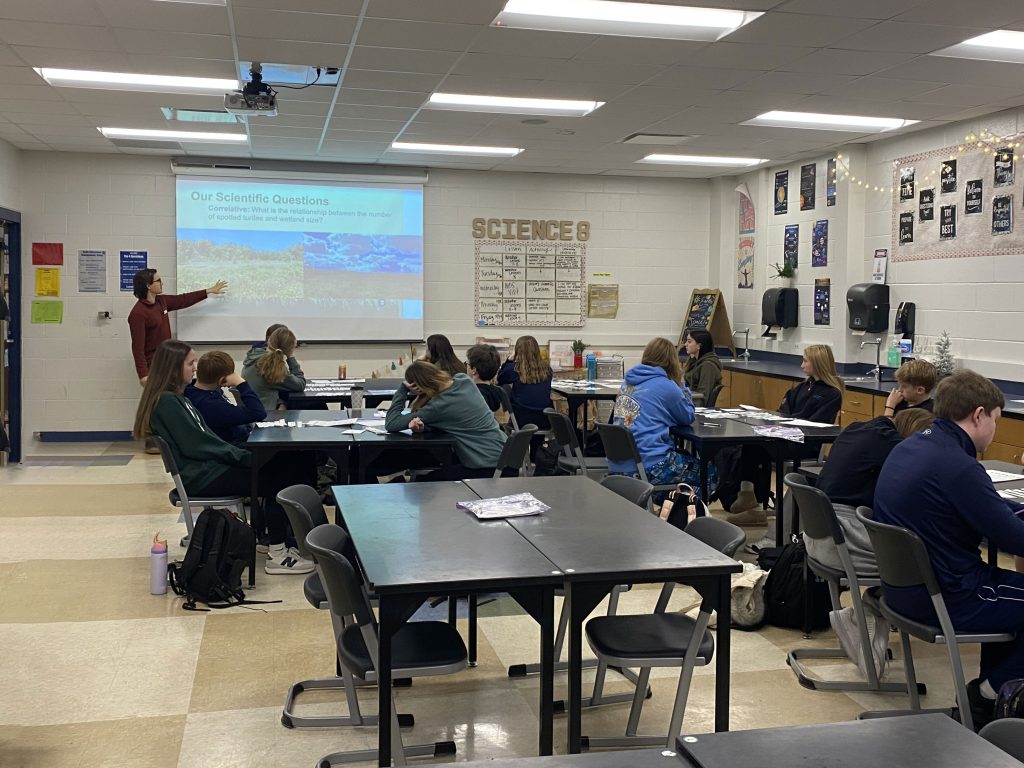
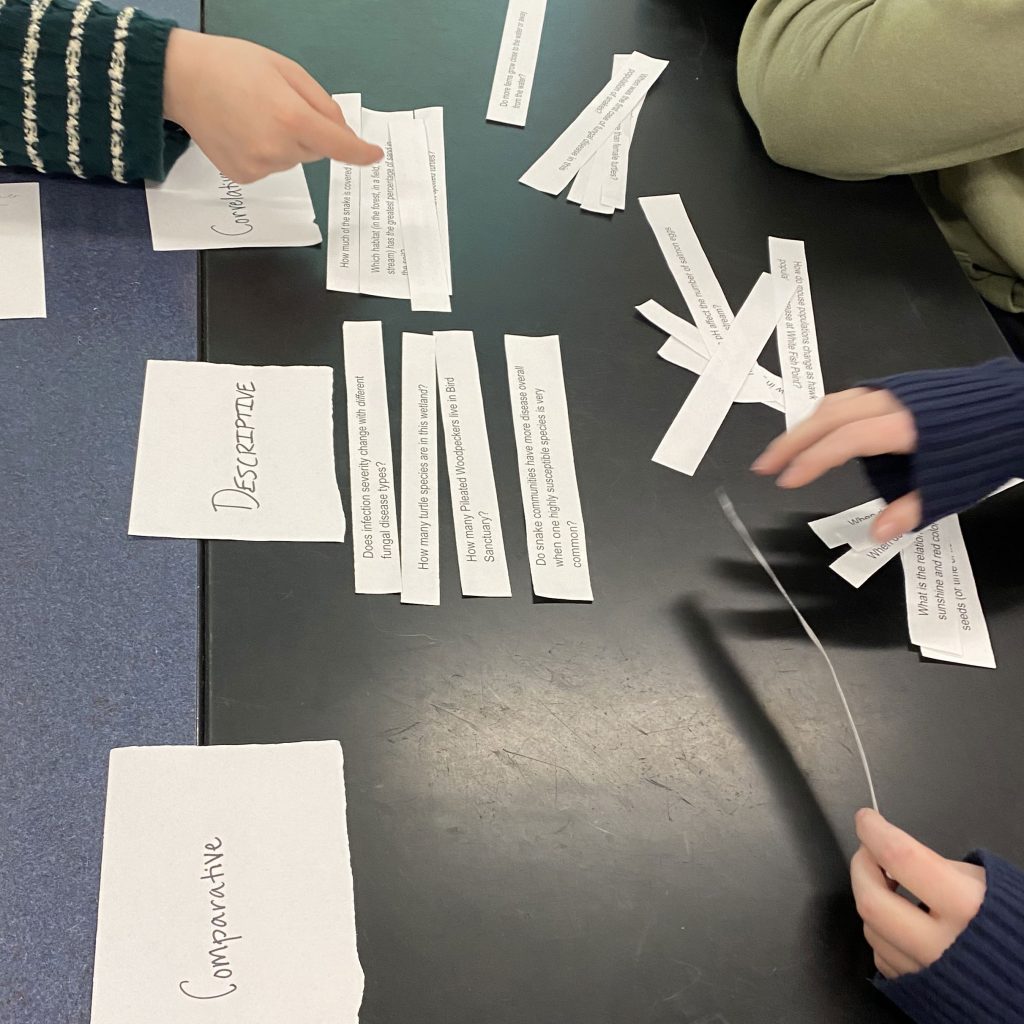
Developing these testable questions from big picture ideas is a skill, one we developed with students during our first visit with Mr. Dalm and Ms. Steinke’s classes. Through some group question-sorting activities, the 8th graders learned the difference between big-picture and testable questions and found out that testable questions come in a variety of flavors: descriptive, comparative, and correlative. To give them an idea of how asking scientific questions works in real life, Hannah Rothkopf and I, this year’s K-12 Science Education and Outreach fellows at KBS, shared how we come up with our own testable questions for our graduate research.
For example, I’m interested in protecting the endangered spotted turtle, and I do so by answering descriptive questions about where they live, comparative questions about whether male or female turtles need more space, and correlative questions like whether larger wetlands have larger turtle populations. By the end of each class, students were coming up with questions they found interesting and that they could answer themselves in the outdoor classroom!
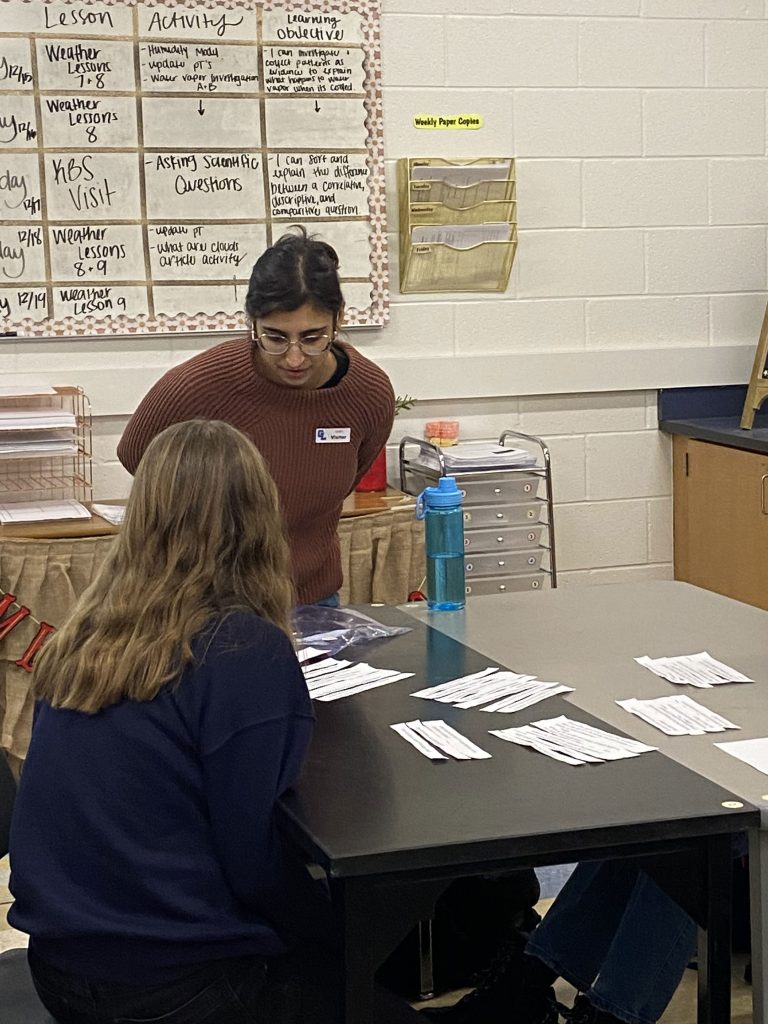
“It was awesome to [meet] real life scientists and see what they do. I like that they taught us about what they study, how they study and what goes through their mind then they’re studying,” said one student.
“Having these scientists come in and visit our class was indubitably, most definitely one of the greatest experiences in my science class career. I will forever relish it,” said another.
What comes next?
Science isn’t just asking questions, of course; it’s answering them as well. So once the weather warms up in the spring, our K-12 team will return to Gull Lake Middle School to take Mr. Dalm and Ms. Steinke’s students to the outdoor classroom. There, we’ll guide each class through the scientific process of observation, data collection, and interpretation. Most importantly, through this process of outdoor investigation, these 8th graders won’t just be hearing about science – they’ll be doing science, coming up with and answering their very own scientific questions without ever having to leave school property! I think that’s pretty neat.
More opportunities
If you’re a science educator interested in providing your students with hands-on learning experiences, consider enrolling in a field experience through the Kellogg Bird Sanctuary. Opportunities include sampling aquatic macroinvertebrates in Wintergreen Lake to assess water quality, meeting the Sanctuary’s birds of prey, and dissecting owl pellets to reveal their diet. Alternatively, check out our free lesson plans and sign up for the K-12 Partnership newsletter to stay up to date on educational events hosted by KBS, grants, teaching resources, and more.
~~~~~~~~~~~~~~~~~~~~
Caleb Krueger is a Ph.D. student in the Janzen Lab at the W. K. Kellogg Biological Station and a 2025-26 science education and outreach fellow. He studies the endangered spotted turtle to improve conservation and management efforts, and he also studies the evolution of sex-determining mechanisms in reptiles, where incubation temperatures often determine whether eggs produce males or females.
~~~~~~~~~~~~~~~~~~~~
A legacy of conservation; a commitment to sustainability.
3700 E. Gull Lake Drive
Hickory Corners, MI 49060
(269) 671-5117
info@kbs.msu.edu
Find us on social media.