
Roads, buildings and farms are preventing Michigan’s only rattlesnake from finding mates outside of their population. A 15-year study shows that fragmentation into smaller, more isolated patches is likely reducing the threatened snake’s chances of survival.
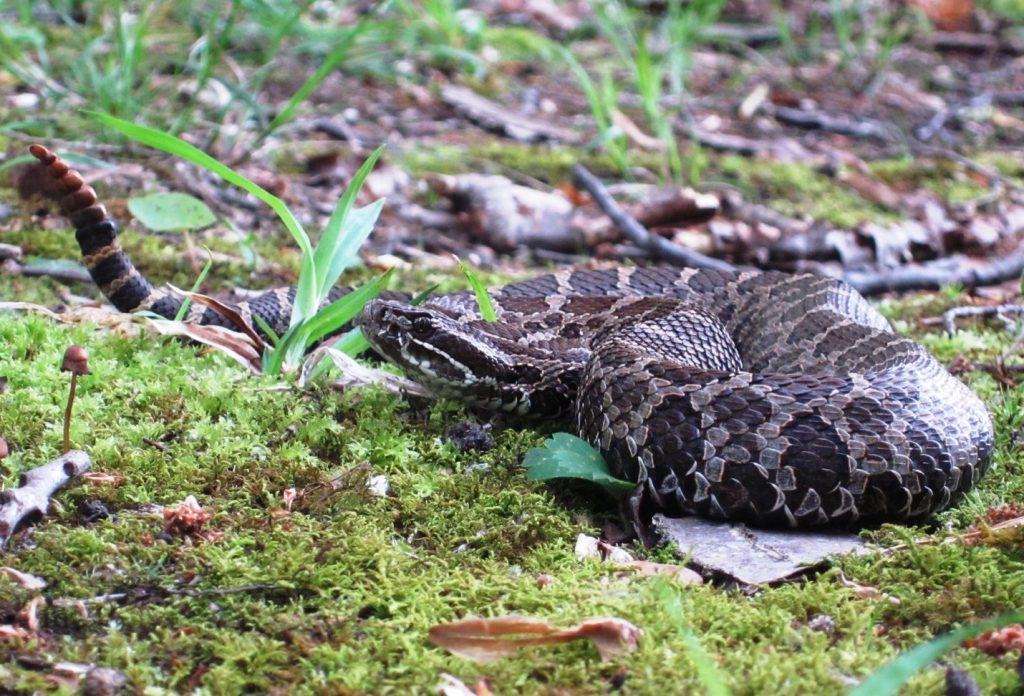
Michigan State University conservation biologists traced the family histories of more than 1,000 Eastern Massasauga rattlesnakes caught and released in a U.S. Fish and Wildlife Service-funded project. The findings, published in the Proceedings of the National Academy of Sciences, surprised even the researchers – the most inbred snakes were 13% less likely to have surviving offspring and had a nearly 12% lower annual survival rate.
A need for more connected habitats
These results paint a striking picture of the need for rattlesnake habitat connectivity to be restored, said Sarah Fitzpatrick, associate professor in MSU’s Department of Integrative Biology and resident faculty at the W.K. Kellogg Biological Station.
“These are fairly large and stable populations of Eastern Massasaugas,” said Fitzpatrick, a senior author on the study. “The fact that we’re detecting problems from inbreeding in these populations is concerning, given that many other populations throughout the Midwest are much smaller and even more fragmented.”
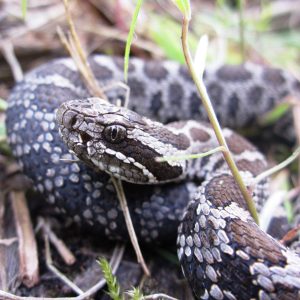
Eastern Massasauga rattlesnakes are a keystone species of wetland food webs throughout the Midwest, meaning that they’re critical to the health of their habitat. They hunt prey like mice and rats that otherwise might run rampant in nearby homes and barns. If rattlesnakes disappeared, the entire balance of the ecosystem would be disrupted, said Meaghan Clark, lead author and former MSU graduate student in Fitzpatrick’s lab.
These rattlesnakes typically don’t like to venture beyond the wetland where they were born. They may wander to explore a nearby habitat and find a mate before returning home.
But an increasing human presence – and developments such as roads, farms and houses – are likely keeping Eastern Massasaugas even more homebound. That means when it’s time to choose a mate, they are more likely to end up with a relative instead of an unrelated snake.
“They’re very vulnerable to even minor disturbances to their habitat,” Fitzpatrick said. “Even a single road can isolate populations.”
Eastern Massasauga populations experiencing ‘inbreeding depression’
When animals have offspring with their relatives, there’s usually a negative impact to their babies’ fitness — a term used by researchers to describe how successful an animal is at surviving, producing babies and continuing the species.
A decrease in fitness resulting from inbreeding is known to conservationists as “inbreeding depression.” But that’s difficult to prove in wild populations, especially snakes with a venomous bite.
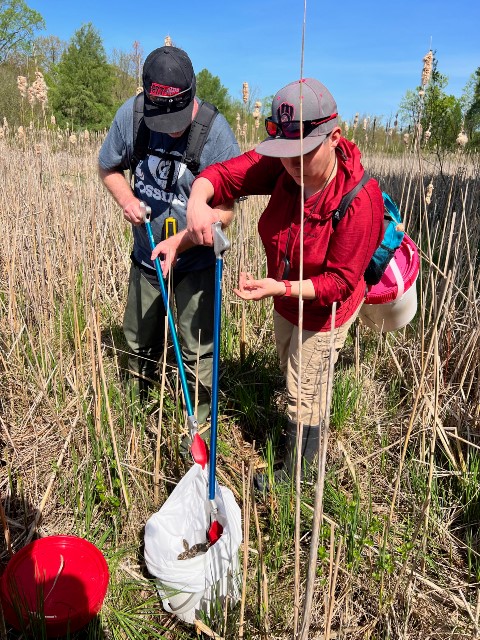
Fitzpatrick’s lab joined forces with long-term monitoring projects in Cass and Barry counties, partnering with Jennifer Moore at Grand Valley State University, Eric Hileman at West Virginia University, and Lisa Faust from the Association of Zoos and Aquariums. Each summer since 2009 and 2011, respectively, their research teams have donned tall rubber boots and armed themselves with snake tongs to trek through wetlands and capture the elusive reptile.
By returning to the same wetlands year after year, researchers could track snakes’ survival based on whether they were eventually recaptured. Genomic sequencing made it possible to generate a family tree for each population, track how many snake babies were born and survived to adulthood, and determine who their parents were.
Fitzpatrick hopes the study informs conservation efforts that help Eastern Massasaugas find mates outside their families, especially in declining populations beyond Michigan. Small changes, like habitat restoration or building road underpasses, could promote more connectivity that would boost the gene pool and give the snakes a better shot at survival. Conservationists could also explore moving imperiled rattlesnakes to new habitats with more options for finding mates.
Related articles
Michigan’s only rattlesnake is inbreeding | Aug. 18, 2025
Habitat loss is leading to inbreeding among Michigan’s only species of venomous snake | Aug. 19, 2025
Inbreeding among Michigan’s rare rattlesnakes is harming their ability to survive | Aug. 19, 2025
A legacy of conservation; a commitment to sustainability.
3700 E. Gull Lake Drive
Hickory Corners, MI 49060
(269) 671-5117
info@kbs.msu.edu