
Michigan State University scientists plan to build a first-of-its-kind outdoor lab to study how solar panels placed alongside crops could save water, improve soil health and support ecosystems, all while boosting farmers’ bottom line and preserving farm production.
The project, led by Earth and Environmental Sciences Assistant Professor Anthony Kendall, is made possible by a five-year $3.6 million National Science Foundation grant. He and an interdisciplinary team will study existing solar parks to find out how the panels affect the soil and ecosystems surrounding them. Then, they’ll install a small array of 30 solar panels near corn and soybean fields to teach farmers, scientists and other stakeholders how to repurpose underproducing portions of their fields for solar energy.
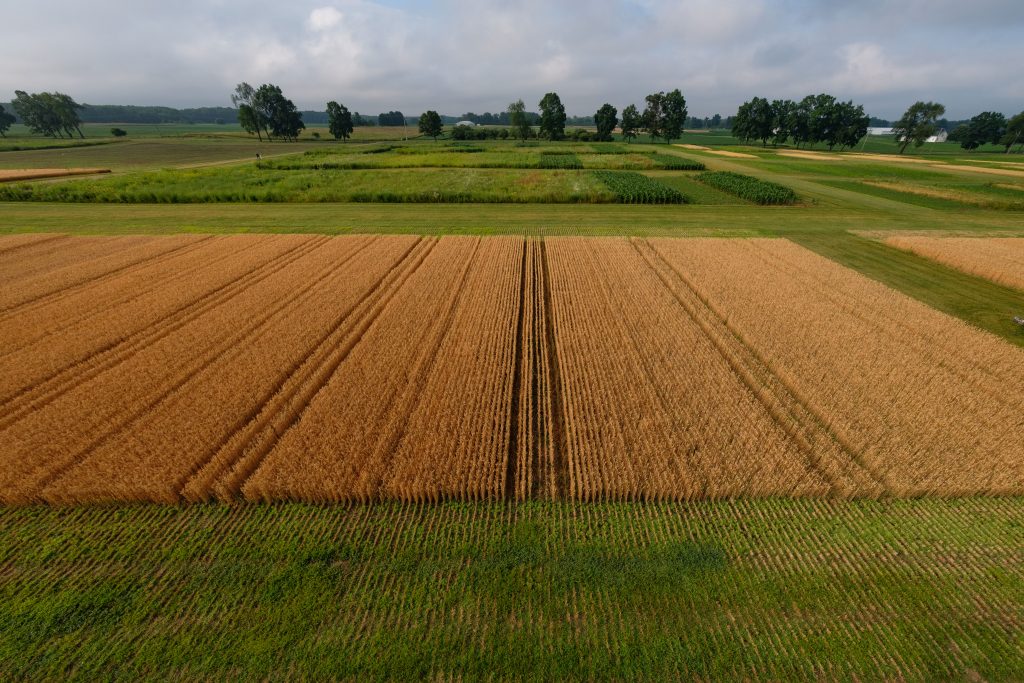
The initial lab is set to be installed at the W.K. Kellogg Biological Station, or KBS. Bringing this concept to life will help farmers visualize what this method could look like in their fields and how it could make farming more sustainable as costs rise.
“There’s really nothing else like this,” Kendall said. “The experiments and education opportunities are crucial as solar energy becomes more widely used worldwide. This lab will help us teach farmers how they can harness energy from the sun to stabilize their income and ensure that they can keep producing crops for generations to come.”
A cross-disciplinary team
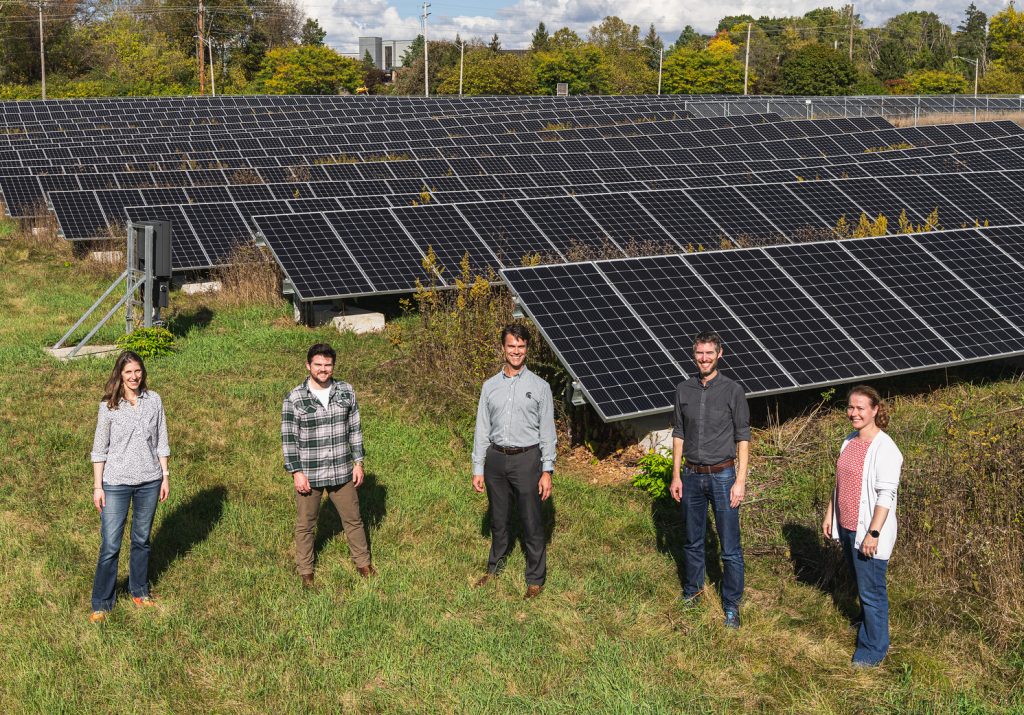
Kendall has brought together a team of MSU scientists with unique expertise to ensure a cross-disciplinary perspective to this research, including:
- Annick Anctil, associate professor of civil and environmental engineering, who will create new metrics for quantifying the benefit of solar panels, incorporating not just the energy benefit but also savings in fertilizer, water and other effects on the ecosystem.
- Bruno Basso, Hannah Distinguished Professor of earth and environmental sciences and plant, soil and microbial sciences, and a KBS faculty member. He’ll use drones and remote sensing to help farmers pinpoint low productivity fields or large low-production areas within fields where they’re losing money due to high inputs and low commodity prices. Those areas could then be converted to solar sites surrounded by crops, increasing revenue for farmers and ecosystems services for the community.
- Nick Haddad, professor of integrative biology, core faculty member in MSU’s Ecology, Evolution and Behavior Program, or EEB, and a resident faculty at KBS, where he is co-director of the KBS Long-Term Ecological Research program. He’ll determine how the solar plots could benefit the balance of plants, animals and microbes that keep the ecosystem healthy. He’ll use techniques such as planting goldenrod, black-eyed Susans, switchgrass and other native plants around solar panels. These plants attract bees, butterflies and insects that pollinate plants and improve crop yields.
- Phoebe Zarnetske, professor of integrative biology and core faculty member in EEB, who is also a principal investigator of the Spatial and Community Ecology Lab and director of the Institute for Biodiversity, Ecology, Evolution and Macrosystems. She will measure how solar panels affect the plants and animals that call a field home.
- Adam Zwickle, associate professor and graduate program director of the Department of Community Sustainability, who will seek to understand farmer and community needs for agri-solar data and ways to incorporate personal and community values into the solar decision-making process.
A surge of solar power
The solar project comes as renewable energy surges worldwide. For the first time ever, solar, wind and other renewable energy sources generated more electricity than coal in the first six months of 2025, according to an energy think tank report that was published in October.
As increasingly extreme weather has led to unreliable crop yields, more farmers are turning to solar energy as a steady source of income. While some convert entire fields to solar farms, research led by MSU research associate Jake Stid shows farmers can keep growing food by strategically placing solar arrays on unproductive patches of field.
Even as solar energy becomes more prominent, installing panels on farmland has stirred debate in many communities. Residents have raised questions about land use, aesthetics and threats to their agricultural heritage. Meanwhile, most solar research was fragmented and conducted in isolation. As a result, scientists don’t know the tradeoffs and benefits of solar panels and how they affect water, ecologies and communities.
That’s why the first 18 months of the five-year grant period will be spent studying local solar parks and developing new interdisciplinary methods and research questions. A goal is for MSU to provide a trusted source of science-based information to help property owners and communities make informed decisions about how best to use their land.
The agri-solar project also includes contributions from additional MSU senior research personnel, including Nameer Baker, ecology specialist at KBS; Doug Bessette, associate professor of community sustainability; Lissy Goralnik, assistant professor of community sustainability; M. Charles Gould, MSU Extension educator; Megan Halpern, associate professor at Lyman Briggs College; Elizabeth Schultheis, KBS education and outreach coordinator; and Gretel Van Wieren, professor of religious studies.
Related article
Solar research to explore land use and farming integration | Nov. 14, 2025
A legacy of conservation; a commitment to sustainability.
3700 E. Gull Lake Drive
Hickory Corners, MI 49060
(269) 671-5117
info@kbs.msu.edu