
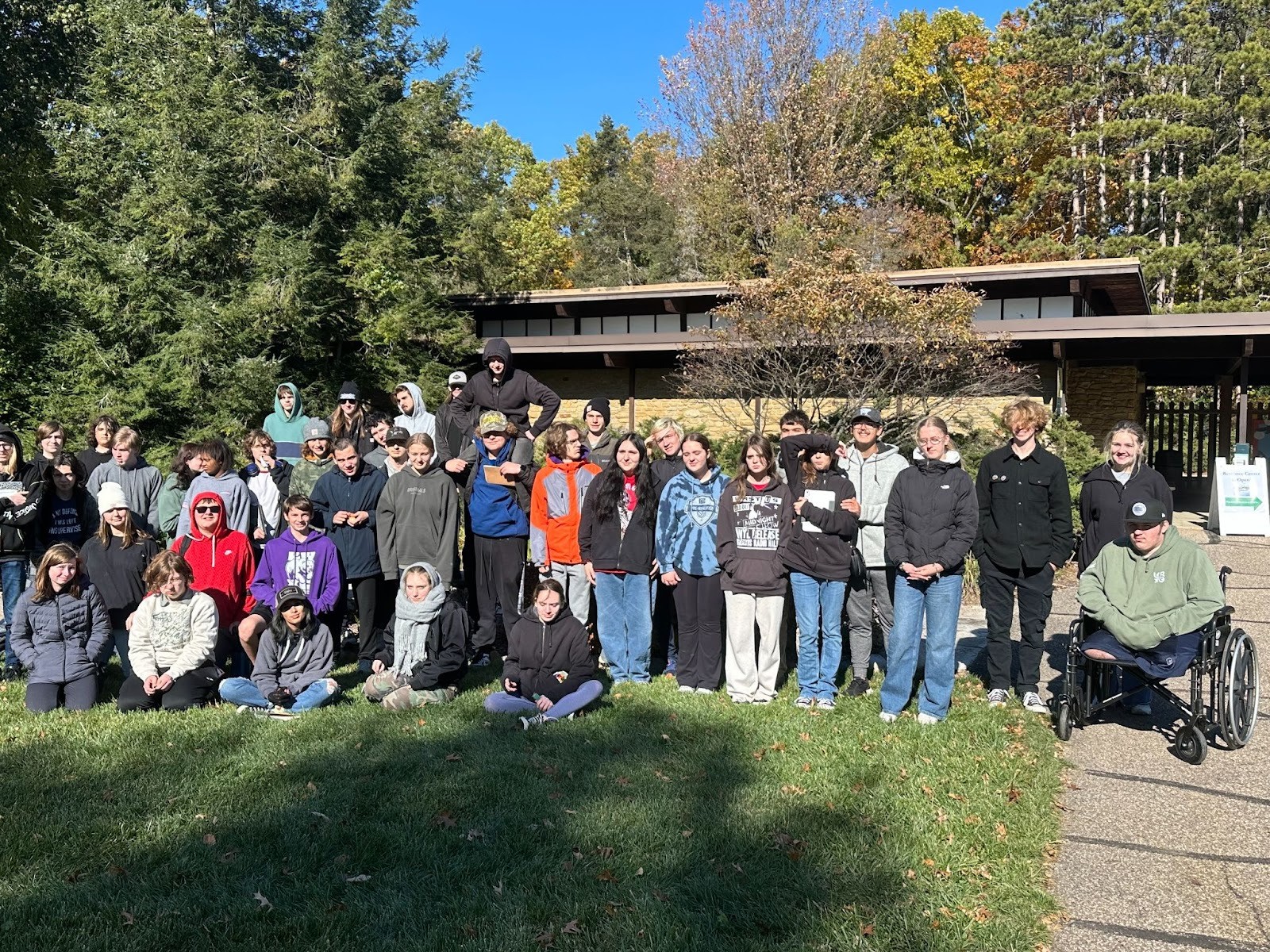
In October 2025, the W.K. Kellogg Biological Station was thrilled to welcome Kensington Woods, or K-Woods, Schools back for a second year of field-based ecological exploration. K-Woods, a charter school in Livingston, Michigan, prides itself on its small, supportive community and its STEAM-focused approach that shows students how creativity and science go hand in hand. That same blend of creativity and scientific curiosity is central to our work at KBS, making this partnership the perfect match. This year, however, we had something new to look forward to: along with returning biology students, K-Woods brought their Environmental Design class for the very first time. Their visit created the perfect opportunity to build on the ecological foundations we explored last year while adding a new layer that both KBS and K-Woods care deeply about—how art and creativity can help us see science, and our environment, in entirely new ways. And with that shared excitement, students launched into another two days of learning and discovering together.
Round two: Even more to explore
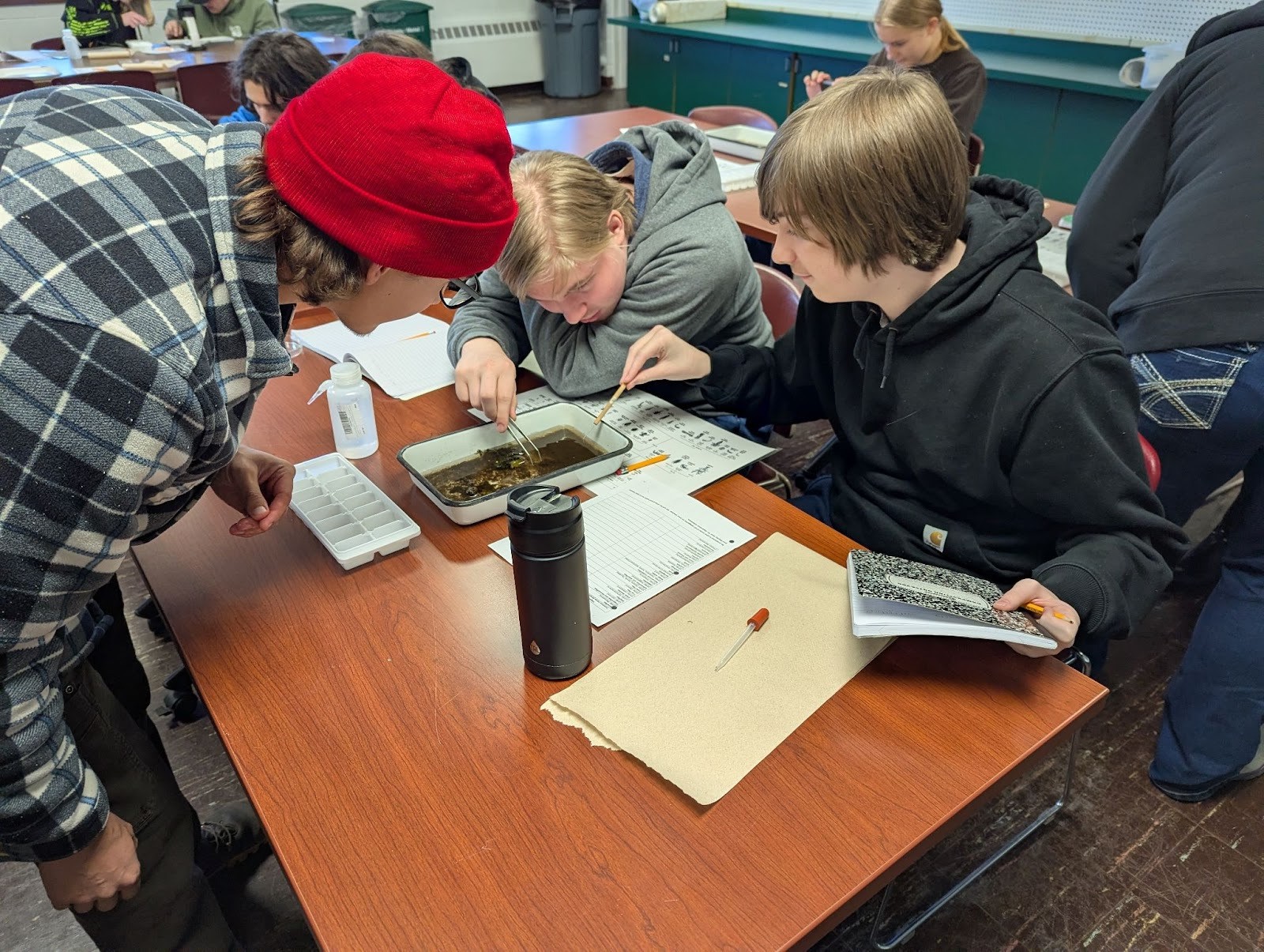
Round two: For the second year, freshman biology students from K-Woods took part in a two-day experience at KBS complete with an overnight stay in the dorms, pizza, games, nature hikes, and, of course, several educational experiences at the Kellogg Bird Sanctuary. At the Bird Sanctuary, students listened as Brenden Kokx, avian caretaker at the Sanctuary, taught them about the ecology and biology of some of Michigan’s native raptors like barn owls, red-tailed hawks, and bald eagles. Then the students watched (or looked away) as he fed the resident raptors. Students also sifted through water samples from Wintergreen Lake to identify aquatic invertebrates and gained hands-on experience determining water quality based on the community composition of the lake’s residents, a method used by biologists and ecologists of all sorts.
“The students are able to make connections to a new group of animals and ecosystems, applying principles they are learning in class to a completely different system,” said their teacher, Elizabeth Belcher. “I feel that it helps them connect their classroom learning to real life jobs.”
Even more to explore: New this year, students also took a look at residents of an entirely different sort of ecosystem—the inside of a barn owl’s digestive system. Owls and other raptors regurgitate pellets of indigestible hair and bones, making it possible to determine what they’re eating without seeing it happen. And though a number of students were apprehensive about “dissecting puke,” many got right to work unwrapping their unusual presents full of small mammal jaws, ribs, and skulls. Yes, biology can be gross, but these freshmen got firsthand experience doing exactly what researchers do to analyze diets or environmental quality. As one student said, “I loved being able to actually feel like I was doing field work.”
Another new twist: Environmental design meets ecology
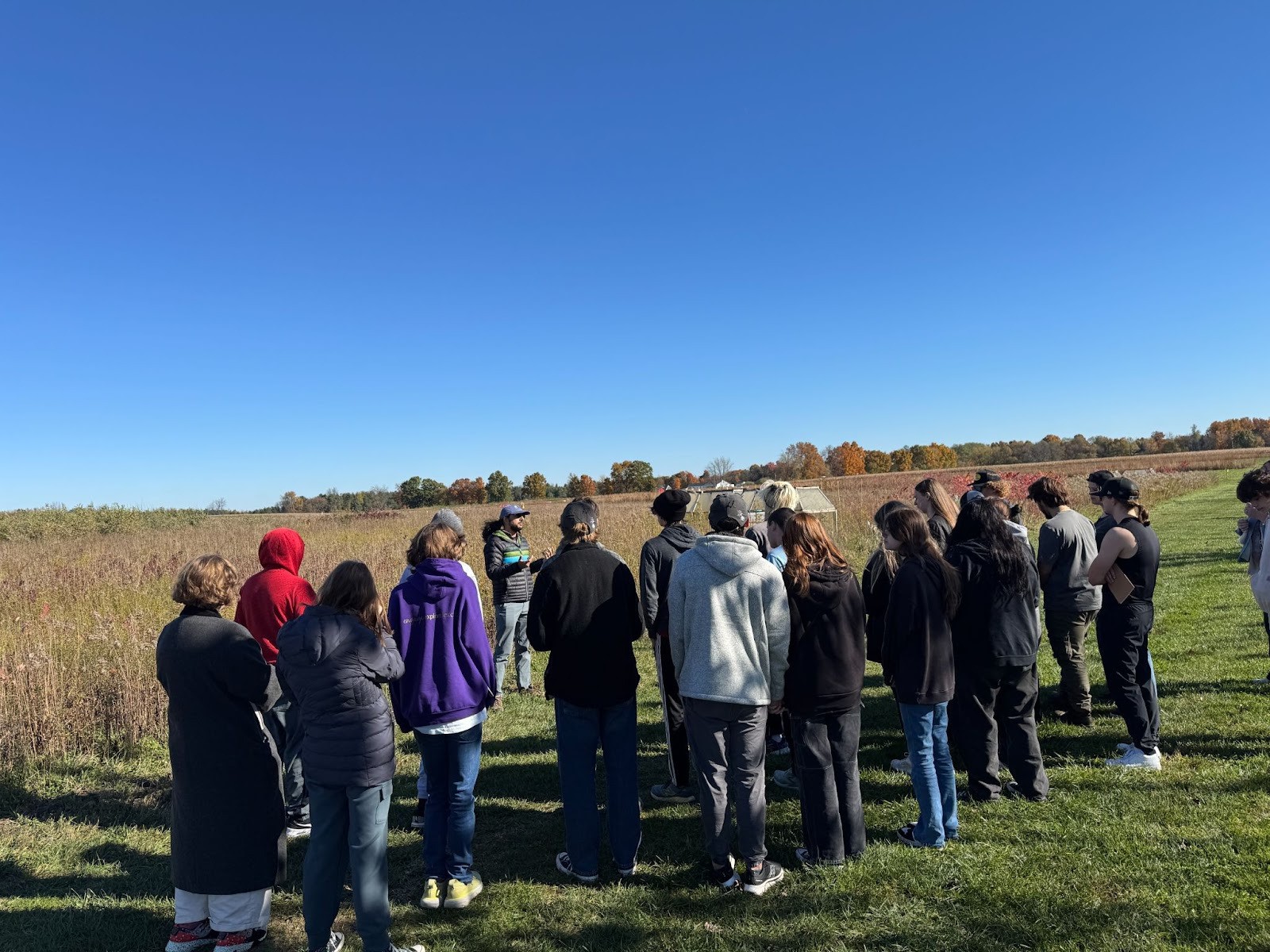
When K-Woods brought their Environmental Design—ENV-D—class to KBS for the first time this year, it felt like a perfect match. K-Woods places a strong emphasis on the “A” in STEAM, recognizing that the arts are an essential part of science that help students and scientists visualize and better understand complex concepts. This connection between art and science is something KBS values deeply as well. We have a long history of artists collaborating with our scientists through programs like the Blending Art and Science workshops, the Artist-in-Residence project, Sounds of Science, and even our weekly seminar chalkboard art. With such a shared passion for creativity and science, the ENV-D visit was a natural fit. The ENV-D class is designed to “get students to understand the impact humans have on the environment and how we can make choices to mitigate that impact or support the ecosystems around us” says K-Woods principal, Jess Pratt. And that’s exactly what their KBS trip aimed to do: give students the chance to investigate how KBS researchers study these impacts up close and use art and design to express what they learned. To show the students how KBS studies how human practices impact the environment, Nameer Baker, Long-Term Ecological Research—LTER—program science coordinator, led the students on a tour of the LTER. He talked to them about the negative impacts agriculture has had on natural Midwestern landscapes, then showed them how humans can mitigate those impacts with novel practices like using “cover crops to reduce their reliance on chemical fertilizer, or how they can plant perennials to create habitat for beneficial insects and birds in low-yielding areas without losing money” which Nameer said, “the students were particularly interested in”.
“Sharing some of the solutions that the LTER is investigating to bring diversity back to these farmscapes was a pleasure!” Nameer said.
After the students had some time to reflect on what they learned with Nameer, local artist Taylor Scamehorn and I, Hannah Rothkopf (master’s student and K-12 science education and outreach fellow at KBS) led the students in a class about how scientists use art to communicate their findings and how artists use scientific thinking to create their work. We began by asking the students to think about how different shapes and symbols hold different meanings to us both implicitly and explicitly by prompting them to draw representations of abstract concepts like heat, cooperation, loss, and time. Then we walked them through how scientists use those implicit and explicit feelings to plan their research and carefully choose specific visuals to communicate their findings to others.
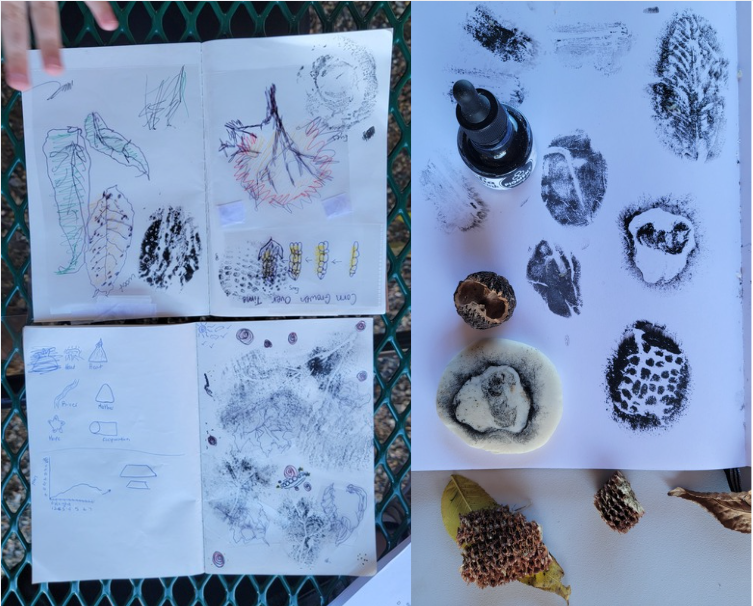
Finally, we brought the students back to the core concepts of their Environmental Design class. We asked students to use resources both provided by Taylor and found in the environment to create an image that represented what they had learned about the research done in the LTER. Creativity flowed as students used Play-Doh to collect textures from objects around the LTER, and pressed them into life with India ink. After collecting their textures, students were given transparency sheets to lay over their prints and flesh out their composition with illustrations of the environment around them. It was incredible to see all the different ways they interpreted what they learned and how they synthesized their findings into something visual. Some gravitated towards only natural materials—corn kernels, walnut shells, leaves, and prairie flowers. Others were drawn to man-made textures like tire tracks or the grain patterns from wood planks. Even when students used similar textures, each design was unique in composition and meaning. Later, students refined their work and collaborated with their teacher and peers to convert their designs into screen prints. Take a look at the students’ initial sketches and final projects. See how they changed over time and think about what they mean to you!
Thoughts from the author: If you’re learning, you’re a student!
Before entering academia, I used to think that finishing my education would mean I had nothing left to learn—how wrong I was! I’ve since realized that learning never truly ends; every day brings something new to discover, whether it’s scientific insight or a better understanding of the world and people around me. Working with K-Woods students was a wonderful reminder that we are all students and continue to be. Seeing the way they asked questions, made connections, and viewed familiar things in fresh ways was inspiring and refreshing. We look forward to seeing how this partnership continues to grow, and how these young scientists and artists will shape the world around them.
~~~~~~~~~~~~~~~~~~~~
Hannah Rothkopf is a M.Sc. student in the Kozackiewicz Lab at the W. K. Kellogg Biological Station and a 2025-26 science education and outreach fellow. She studies how the severity and prevalence of wildlife disease varies across different host species and their environments. To do this she focuses on a fungal disease specific to snakes that has been found in Michigan’s only native rattlesnake, the endangered Eastern Massasauga rattlesnake.
Caleb Krueger is a Ph.D. student in the Janzen Lab at the W. K. Kellogg Biological Station and a 2025-26 science education and outreach fellow. He studies the endangered spotted turtle to improve conservation and management efforts, and he also studies the evolution of sex-determining mechanisms in reptiles, where incubation temperatures often determine whether eggs produce males or females.
~~~~~~~~~~~~~~~~~~~~
A legacy of conservation; a commitment to sustainability.
3700 E. Gull Lake Drive
Hickory Corners, MI 49060
(269) 671-5117
info@kbs.msu.edu
Find us on social media.