
Michigan farmers are teaming up with Michigan State University researcher Christine Sprunger and the W.K. Kellogg Biological Station to explore how land management practices impact soil health.

Sprunger, associate professor of soil health in the Department of Plant, Soil, and Microbial Sciences, based at KBS, is collaborating with more than 90 farmers across Michigan to examine the impact different agricultural practices have on soil health, ecosystem diversity, and crop productivity.
The KBS research team is working closely with partner farms. Researchers collect samples of each farm’s soil, greenhouse gas emissions, and above-ground biomass, while also working with each farm to understand management practices and unique socioeconomic conditions.
“We’re really grateful that so many farmers wanted to participate in the study,” Sprunger said. “We have a large interdisciplinary team working on this project who are getting to know the farmers very well. There is a lot of collaboration and communication with faculty in a wide range of departments at MSU. We get a management survey from each farm that is critical to our study, because we can’t really analyze the data without understanding the management.”
The collaboration allows researchers to collect a large data set to better understand dynamics across different soil types, different climates, and under different management conditions. Future work from this study will also link biophysical results to socioeconomic aspects of regenerative agriculture as well.
Land management’s impact on soil health
The Agricultural Resiliency Program, or ARP, provided $1.25 million over three years to fund the research. ARP is a partnership among MSU AgBioResearch, the Michigan Plant Coalition, and the Michigan Department of Agriculture and Rural Development. The team is comprised of Sprunger and 12 other researchers and Extension educators from MSU.
The team is working to assess factors influencing climate adaptation and mitigation of major commodity crops in Michigan. Researchers are examining how regenerative agriculture practices enhance soil health and yield stability, evaluate the relationship between soil health and greenhouse gas emissions, and identify factors that influence farmer adoption of climate-smart practices.
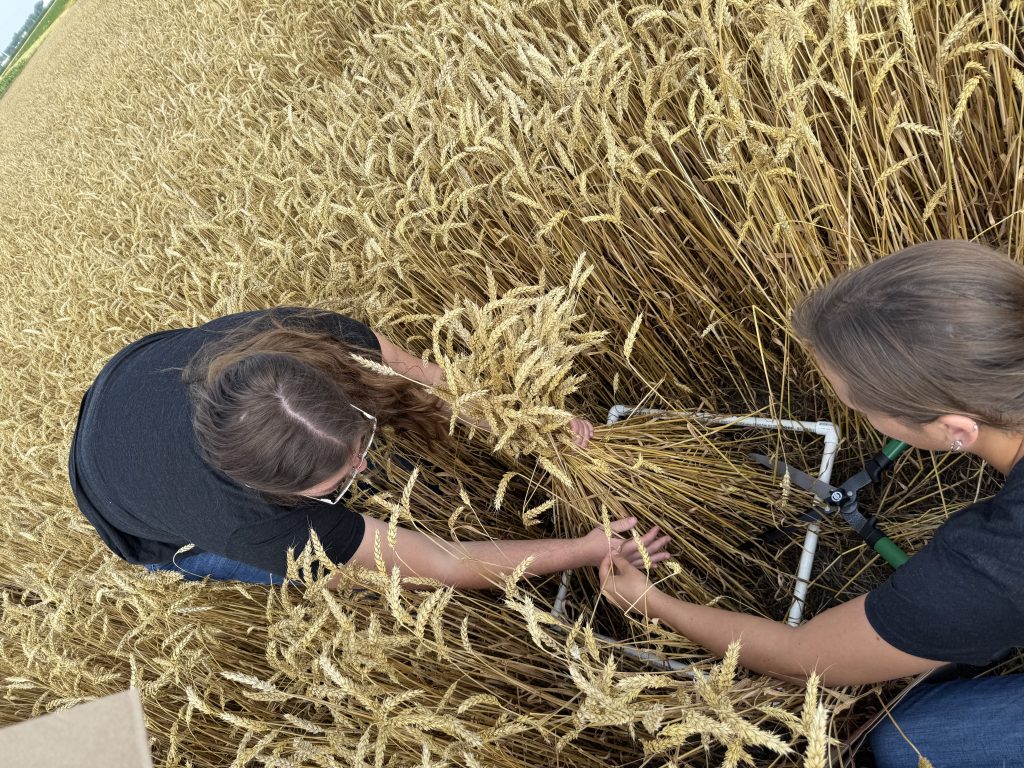
Through the first year of the study, Sprunger said a key finding is that, regardless of soil texture, management practices play a pivotal role in the soil health of a field.
“Fundamental soil science says that your soil texture influences your soil health and your soil organic matter. What our study has found is soil texture does indeed play a role, but we saw multiple instances in which a sandy or silt loam soil had better soil health indicators than a clay soil,” Sprunger said. “That’s showing that management also plays a critical role.”
Practices like reducing the number of tillage passes or incorporating cover crops or perennials have shown to improve soil heath, Sprunger said. “We can definitively say that management can boost your soil health if you’re doing things correctly, even if you’re farming on sandy soil.”
KBS team lends a helping hand
The second year of the study will reduce the sample size to 25 farms and 50 fields but deepen the understanding through more extensive examination of how soil management practices affect soil health, greenhouse gas emissions, above-ground biomass and plant yield.
Collecting and analyzing soil data from more than 90 farms across Michigan required a team of researchers and students from KBS. The Long-Term Agroecosystem Research—LTAR—project at KBS provided critical baseline data for the researchers to compare with farms across the state.
“We have a really large team working on this. I have a Ph.D. student, Monica Jean, working on this full-time. We have a project coordinator, Lisa Hargest, working on this full-time. We have multiple technicians, and they are the ones that really get to know the farmers through their collaborations,” Sprunger said. “Monica has been working with farmers for years in MSU Extension. She has great insight into working with individual farms because she has been on the ground so long doing consultations.”

In addition to pursuing a Ph.D. in the Department of Plant, Soil and Microbial Sciences in Sprunger’s Lab, Jean is a field crop educator for MSU Extension, serving central lower Michigan with an emphasis on the Saginaw Bay watershed region.
“I am almost in my tenth year of being an Extension educator. I love visiting our farms, working on pest and management issues with the growers and helping my community thrive through farming and food production,” said Jean, whose position covers a large variety of crop production including corn, soybean, edible dry beans, potato and integrated crop and livestock systems.
Results from this study will inform growers across the state on the most successful management practices for the diverse soil types across Michigan. MSU faculty and Extension educators will also have an extensive database to further inform growers on how new management practices might improve soil quality.
Prairie strips play key role in ecosystem health
In 2023, Sprunger, KBS colleague Nick Haddad and Marshall McDaniel, associate professor in soil-plant interactions at Iowa State University, received funding from the Bayer Initiative to examine short- and long-term impacts of prairie strips on partner farms. This work was then extended by a Sustainable Agriculture Research and Education, or SARE, award with collaborators Kathryn Docherty and Elizabeth Schultheis.
Sprunger’s team is working with farmers in Michigan and Iowa with varying degrees of prairie strip experience. The research explores the influence of prairie strips on soil health and farm yields.
Insect pollinator diversity decline has consequences for local and global food production. Researchers have determined land-use change in agriculture is the leading cause of biodiversity loss, Sprunger said. The team is examining how prairie strips might help negate some of agriculture’s adverse effects on pollinators and soil diversity.
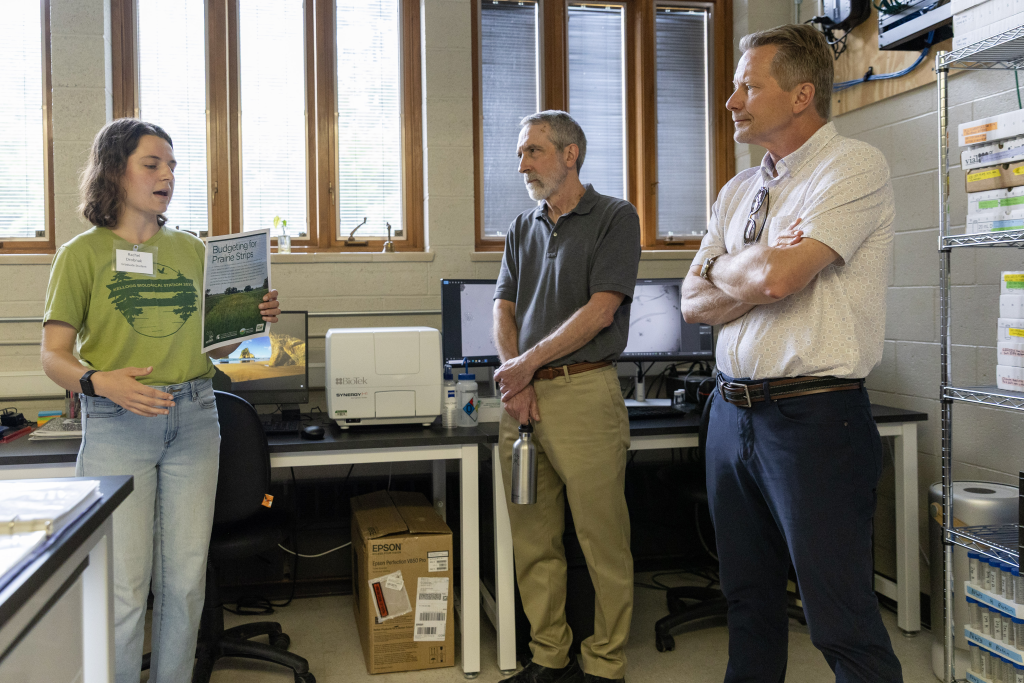
“Incorporating prairie strips within row-crop agriculture is an innovative strategy that could reverse biodiversity trends, while simultaneously providing farmers with additional income via bailing prairie vegetation,” Sprunger said. “My Ph.D. student, Rachel Drobnak, and I visited the Ecological Society of America in August, where Rachel presented some interesting findings on the difference in soil health between prairie strips and adjacent row crops. This study is capturing information on working Michigan farms, so we can see that prairie strips are working out in the real world on real farms.”
The study funded via SARE examines how prairie strips influence soil health and crop productivity using the LTAR site located at KBS. Data gathered from the LTAR will be paired with information from on-farm trials ranging from newly installed strips to ones that have been in place for nearly a decade.
Working with farmers to examine prairie strip benefits
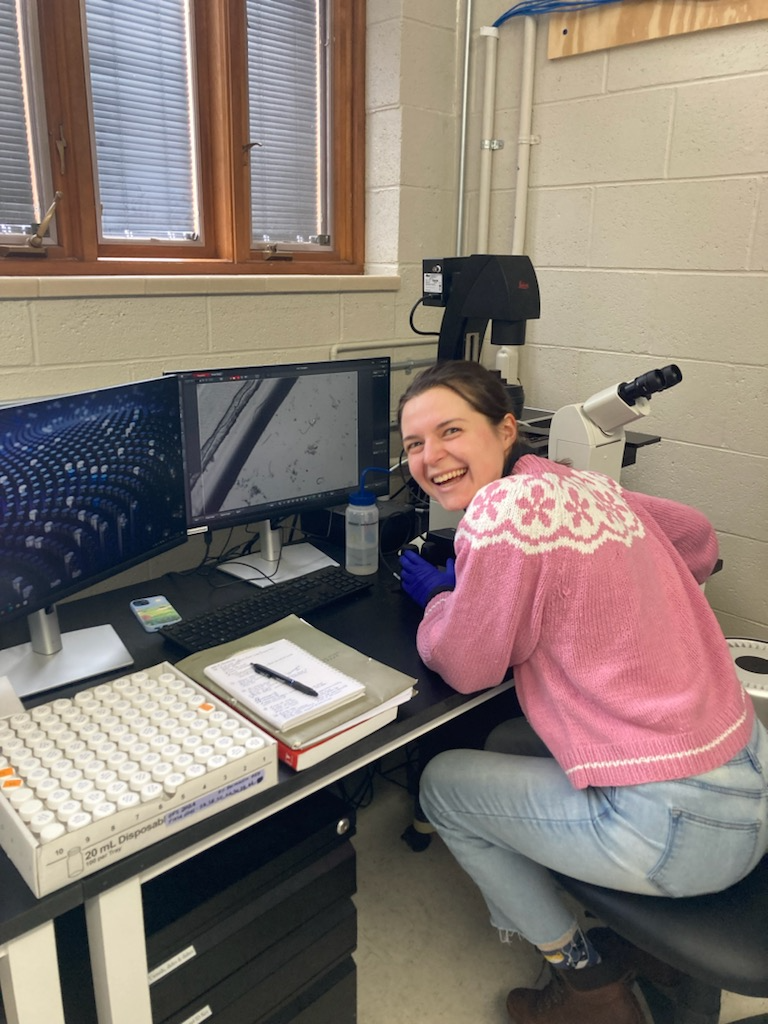
Drobnak is a third-year graduate student and earned a bachelor’s degree in Crop and Soil Sciences from MSU in 2023. Her doctoral research is focused on how conservation practices impact soil health; specifically, implementing prairie strips as a practice to assist farmers in converting their farmland into prairie.
Drobnak is contributing to the overall examination of prairie strips by working with six farm partners to examine eight different farms across Michigan to evaluate how prairie strips impact soil health through multiple different factors, as well as examining the economics of conservation practices.
“I’ve developed soil health reports and consulted with our farm partners, trying to educate myself on their practices and provide them information on soil health. It’s been great to work one-on-one with farmers,” said Drobnak, who previously worked with Monica Jean for a summer as Extension educator in between undergraduate and graduate school at MSU. “That really was an impactful experience to solidify my interest and passion in working with farmers in Michigan.”
Data from the prairie strip research, which continues through the end of 2026, will inform how this practice impacts soil health across a variety of soil types and crop rotations.
Since its launch in July 2021, the MiSTRIPS program at the KBS Long-Term Ecological Research program, or LTER, has established more than 50 acres of prairie in agricultural lands across Michigan that have helped to improve water quality, increase wildlife diversity, and build soil health.
Read the original article from MSU Extension.
Related articles
Michigan State University researcher examines impact of management practices on Michigan farms | Dec. 29, 2025
Examining the impact of management practices on Michigan farms | Jan. 12, 2026
A legacy of conservation; a commitment to sustainability.
3700 E. Gull Lake Drive
Hickory Corners, MI 49060
(269) 671-5117
info@kbs.msu.edu
Find us on social media.