
It is easy to remember the sight of my childhood home, or any of my favorite places, but it takes effort to adorn those images accurately with sound. I remember being told at some point that bias towards sight is true of most people; indeed, I have many times been asked by somebody to picture a place far away, but rarely, if ever, to hear one.
Is there something to be gained by giving sound some of the attention we normally reserve for light? This summer I recorded sounds for the Sounds of Science project at the W.K. Kellogg Biological Station. My job was to build a library of nature and science-related sounds from around KBS for use in future science communication and outreach efforts. This project required me to listen to the world with more intent than I ever have before, and in so doing I learned things that my eyes could never have taught me.
The value of listening: Some examples
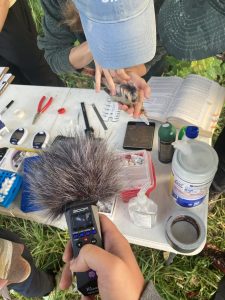
It was through listening that I learned how different insect species come awake at slightly different times as day turns to dusk. I cannot tell you the names of the species I heard one evening at Lux Arbor, a huge KBS property with a variety of natural habitats restored from agricultural land, but I can remember their sequence of voices – a consistent whir was joined by a repetitive creak, which was then joined by sporadic buzzing, and so on. That I could not see and cannot picture with any precision these bugs who annotate the change of day to night in summer – and who do so at a finer scale than my eyes can discern the actual darkening of the sky – suggests I may benefit from taking a little energy from my eyes and putting it toward my ears.
It was also by listening that I realized how rarely my senses are free from subtle pillaging by humankind and its machines, even in places I’d consider relatively natural. Recordings of wheat fields stirring in the wind at KBS Long Term Agricultural Research plots were unavoidably contaminated by the rattling of cars and trucks down 40th Street several hundred yards away. Burping frogs and whistling birds at the KBS Bird Sanctuary were accompanied by the harsh hum of boats on Gull Lake and lawnmowers who-knows-where. Even in Lux Arbor, where certain views seem to approximate the primordial, moments without the violent drone of a single-engine plane or the distant roar of a passenger jet were rare. While I may have once been satisfied with the authenticity of natural places that look like the real thing, paying attention to sound this summer has taught me that my standards, perhaps, were low.
All in all, recording sounds has taught me the immense value of exercising my ears. I am now convinced that the present is enriched by effort put into listening, and memories are made more vivid and precise by having listened.
Future of the recordings
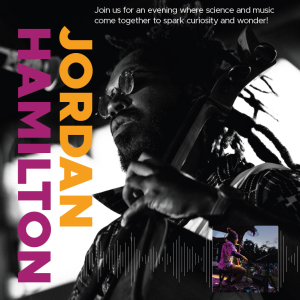
The sounds I recorded will now be used by local Kalamazoo musician Jordan Hamilton, the KBS outreach team, and the Organization for Biological Field Stations. Jordan Hamilton is currently working to create nature and science inspired music to complement short talks given by KBS faculty, staff, and student researchers about their inspiring research which will be jointly performed at the MSU Science Festival event Sound and Science. Please join us on Wednesday, April 8, at the Alley Cat in Kalamazoo, and on Thursday, April 30, at the Robin Theater in Lansing to give your eyes a break and take some time to listen to science and nature.
In a world with so many screens, we run the risk of becoming satisfied with lives composed mainly of visual illusions. My hope is that the sounds I recorded and their pairing with music and science will help fortify the public’s media-based experience of nature and ultimately inspire somebody to go out and experience it for themselves. It is easy to deceive one sense, but it is difficult to deceive them all.
~~~~~~~~~~~~~~~~~~~~
James Bingman is a Ph.D. student in the Conner Lab at the W.K. Kellogg Biological Station and a summer 2025 Science Fellow. He uses fieldwork and genetics to understand how trait differences evolve in plants.
~~~~~~~~~~~~~~~~~~~~
A legacy of conservation; a commitment to sustainability.
3700 E. Gull Lake Drive
Hickory Corners, MI 49060
(269) 671-5117
info@kbs.msu.edu
Find us on social media.