
From deadly heat waves to unprecedented flooding, devastating wildfires to record-breaking droughts, extreme weather is becoming the new normal. As these events become more frequent and widespread, some denizens of our oceans, forests, deserts and grasslands will manage to cope and bounce back. But new research, published March 20 in the journal American Naturalist, asks: could some species and ecosystems not only survive shocks, but thrive because of them?
For the research, a team of Michigan State University scientists based at the W.K. Kellogg Biological Station — made up of Jonas Wickman, a postdoctoral fellow in the Ecology, Evolution and Behavior program; and Christopher Klausmeier and Elena Litchman, both EEB core faculty and MSU Research Foundation Distinguished Professors — examined mathematical models of how living things respond to changing conditions. Their research was supported by a grant from the U.S. National Science Foundation.

Who might thrive, not just survive
Extreme weather is becoming more frequent and more intense as the world warms, previous studies show. In the last 20 years major floods have more than doubled and severe storms have increased by 40%.
For years, scientists interested in the impacts of such events have focused on resilience. But while resilience is critical — it helps ecosystems cope with and recover from stress — resilient things are at best unharmed. So, Litchman and colleagues got to thinking: Could they identify things in nature that are actually strengthened by volatility?
If so, perhaps they could use that information to help ecosystems not just weather storms, heat waves and droughts, but emerge stronger on the other side.
In one set of models, the team examined the impact of temperature swings on phytoplankton.
These tiny aquatic organisms drift around with the ocean currents and photosynthesize, using sunlight and CO2 to produce their energy just like plants do on land.

It’s this ability to remove heat-trapping carbon dioxide from the air that makes phytoplankton important players in moderating global warming.
They are also the foundation of the marine food web, feeding small animals such as krill or jellyfish, which are in turn eaten by larger creatures like sharks and whales.
But when the researchers modeled how phytoplankton species fare under fluctuating temperatures, something remarkable happened.
As the annual swings between warm and cold intensified, the amount of biomass some phytoplankton species produced — a measure of their ability to function — declined. But collectively, the productivity of the community went up.
In other words, in the aggregate, phytoplankton species didn’t just withstand the temperature roller coaster, they harnessed the ups and downs and flourished.
In another set of mathematical models, the researchers looked at hypothetical species whose members varied in terms of how well suited they were for life in a certain environment. These species were able to adapt and outcompete more uniform species when conditions such as rainfall or temperature started to fluctuate. By hedging their bets, they outperformed other species in the face of whatever conditions might arise.
The idea of ‘antifragility’
These unexpected responses are an example of a concept called “antifragility,” Litchman said.
First coined in 2012 by a former trader and risk analyst named Nassim Nicholas Taleb, the term refers to things that gain from volatility rather than just withstanding it.
The concept has since been applied to fields ranging from finance to cancer to engineering.
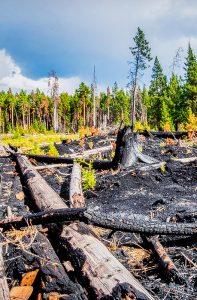
Litchman says the phenomenon can be found elsewhere in nature too. Think about how some grasslands or woodlands grow back more lush or diverse after wildfires or grazing, she said.
“It’s a phenomenon that cuts across so many different contexts and disciplines,” Litchman said.
What’s next
As a next step, Wickman, Klausmeier and Litchman are looking at how warming impacts phytoplankton’s ability to capture carbon dioxide from the atmosphere. Altogether, phytoplankton remove four times as much carbon dioxide as the Amazon rainforest. That amounts to nearly a third of our greenhouse gas emissions each year — emissions that would otherwise continue trapping heat and warming the planet. If this ability is even modestly antifragile, the team said, it could have large consequences for the pace of global warming.
The researchers cautioned against being too quick to declare a given species or ecosystem “antifragile.” As with many things, the devil is in the details, Wickman said.
In the case of phytoplankton, for example, he found that whether productivity is antifragile or not depends on what forces keeps their numbers in check. Their research also revealed that one measure of an organism’s performance might thrive amid chaos while another measure suffers.
But they say that by understanding the science of antifragility, researchers may be able to come up with ways to better restore or manage ecosystems in an uncertain world.
Related article
Extreme weather could help some species thrive, not just survive | Earth.com, March 23, 2026
A legacy of conservation; a commitment to sustainability.
3700 E. Gull Lake Drive
Hickory Corners, MI 49060
(269) 671-5117
info@kbs.msu.edu
Find us on social media.